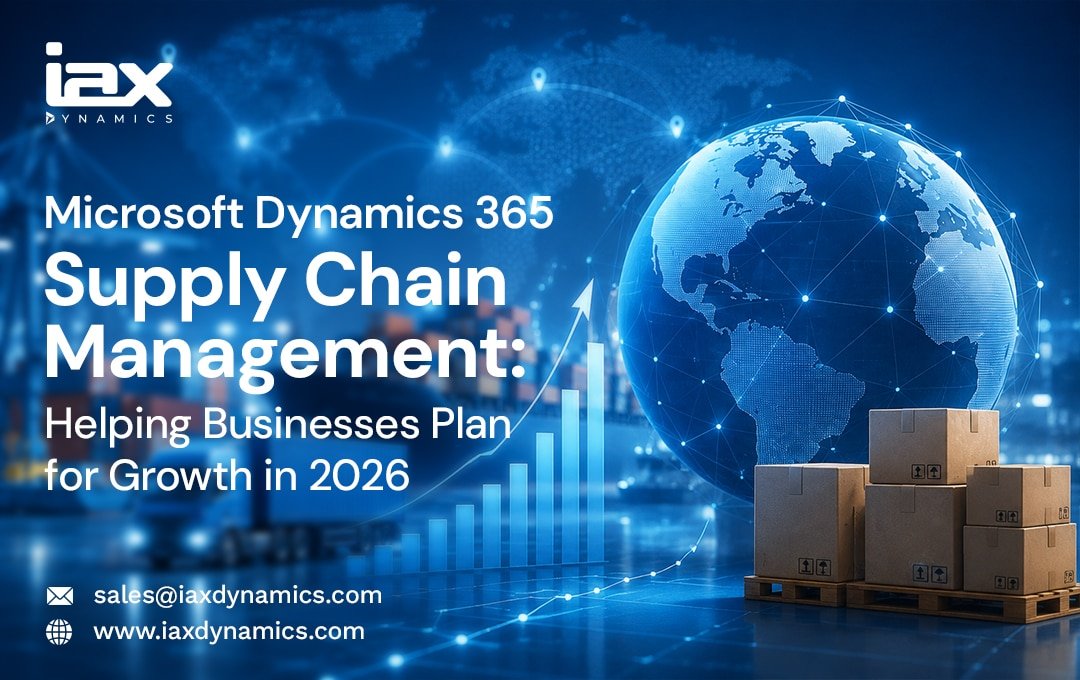
Navigating challenges within the supply chain remains a priority. Moreover, organizations in 2026 will still see this as critical.
Instead of relying on legacy systems, organizations should modernize. Transitioning to Microsoft Dynamics 365 Supply Chain Management has become inevitable.
Leaders recognize that Microsoft Dynamics 365 ERP is essential for overcoming rising complexities in the supply chain.
Additionally, by combining AI, automation, and real-time analytics, this supply chain management software optimizes operations.
Consequently, it improves inventory and supplier collaboration to help build resilient supply chains.
For companies focusing on improving operations, the D365 SCM solution is a key driver for growth in 2026 and beyond.
Dynamics 365 SCM is a cloud-based supply chain ERP.
Additionally, it helps businesses manage procurement, inventory, warehouse operations, production, logistics, and asset management.
These processes are integrated into a single platform. Thus, they enable teams to gain full control over all supply chain activities.
AI in supply chain management, along with Copilot and AI agents, heavily influences decision-making. Additionally, it affects demand forecasting, inventory optimization, supply chain planning, and route optimization.
AI automates information gathering and provides smart recommendations to streamline workflows. Additionally, More importantly, it analyzes both historical and real-time data to uncover hidden patterns. This automated analysis eliminates tedious manual data processing, allowing teams to shift their focus toward strategic planning.
Why Microsoft Dynamics 365 Supply Chain Management matters
Why Dynamics 365 SCM software matters?
Supply chains are growing increasingly complex due to expanding global supplier dependencies, frequent demand fluctuations, inventory imbalances, rising logistics costs, fluctuating geopolitical events, and changing compliance regulations.
The ERP addresses these critical challenges through AI-powered demand forecasting, inventory optimization, production planning, warehouse automation, and logistics management.
Here we delve into reasons why supply chain management software is an excellent choice for manufacturing, retail, and other industries.
Supply Chain Visibility
The ERP unify data into a single platform. This means that all departments are connected together, helping businesses to avoid using separate software for managing procurement, inventory, manufacturing, warehousing, and logistics.
Procurement teams can evaluate vendor performance by tracking delivery timelines, order accuracy, and responsiveness. This complete visibility into purchase order processes gives procurement teams the confidence that items will arrive on time.
Similarly, inventory teams gain real-time inventory visibility across warehouses, retail locations, and distribution centers. By tracking inventory movement, businesses can know how much inventory is left and how much needs to be ordered.
Beyond this, the software provides visibility into manufacturing, warehouse activities, shipment tracking, and delivery performance. This comprehensive visibility empowers teams to make proactive decisions and avoid potential disruptions early.
AI in Supply Chain Management
Demand Forecasting
Precise demand forecasting is a core highlight of the ERP platform. By evaluating historical sales data, customer buying trends, supplier performance, and external market conditions, the built-in AI allows enterprises to accurately predict future market needs.
Consequently, manufacturing inventory can be seamlessly optimized, entirely eliminating the financial risks associated with overstocking and costly stock-out scenarios.
Intelligent Supply Chain Automation
AI automates repetitive supply chain processes that reduce manual effort. Organizations can free up employee time so that they can focus on strategic activities that create true business value.
Microsoft Copilot powers this automation directly across procurement, demand planning, inventory management, and warehouse operations. Users can interact with Copilot AI using their natural language to automate processes and generate insights from data.
Risk Detection and Disruption Management
AI in supply chain management uses machine learning models to identify risks by analyzing supplier performance, inventory levels, and transportation status. Potential issues are identified early so business can make faster decisions to avert problems.
AI identifies anomalies from external signals which helps in preventing risks such as supplier delays, demand spikes, or logistics problems before they escalate into major disruptions.
If any transportation issue is identified, AI suggests alternative routes to reduce the impact on delivery timelines. The Copilot guides users with insights that help teams to make sure flawless operations.
Dynamics 365 Supply Chain Insights
Enterprises can overcome fluctuations and risks through supply chain Insights. The insights provide end-to-end visibility predict potential disruptions, and assess risks by collecting and analyzing supply chain data from various sources.
Insights empower operations teams to forecast demand, identify risks, and provide actionable recommendations. Microsoft Copilot integration also helps teams generate these insights using natural language queries.
Inventory Optimization
AI helps with inventory optimization through real-time insights. It monitors inventory levels with every purchase and sale across various locations and responds dynamically to any shortages to meet customer demand. This ensures that the right products are available at the right time and in the right place.
Core Operations management
Warehouse Management: Warehouse activities are intelligently managed with advanced capabilities. The solution supports mobile warehouse management, barcode scanning, cross-docking, and smart picking strategies. With this unified management of warehouse operations, order fulfillment processes are precisely executed.
Procurement Management: Dynamics 365 SCM supports smarter procurement with a focus on supplier collaboration, cost optimization, and risk management. The path to smarter procurement covers automated purchase requisitions, quotation comparison, vendor performance management, and procurement spend monitoring.
Manufacturing Excellence: D365 SCM solution provides visibility into production. It supports discrete manufacturing, process manufacturing, and lean manufacturing. Production teams can move forward with smart planning, resource allocation, shop floor execution, and capacity planning. All these features combined together generate reliable manufacturing outcomes.
Microsoft Integration
The core advantage of this supply chain visibility software is that it seamlessly integrates with Microsoft platforms. Organizations can extend the capabilities of the SCM software through integration with Dynamics 365 Finance, Power BI, Power Apps, Microsoft Teams, Azure, and Microsoft Fabric.
The integration helps businesses increase analytics capabilities, create custom business apps, effectively use data to generate meaningful insights, and apply automation to tedious business processes.
In the journey toward Dynamics 365 Implementation Services, you must partner with an experienced and reliable Microsoft Dynamics 365 Partner.
Empower Growth with Dynamics 365 Implementation Services.
The AI-driven capabilities improve operations across all supply chain areas, which leads to growth now and in the future. The next step would be to proceed with Dynamics 365 implementation services with leading Microsoft Dynamics 365 solution providers.
IAX DYNAMICS ensures successful Dynamics 365 SCM implementation for your business through tailored customizations. Their experienced consultants assess your operational environment, design optimized workflows, configure the platform, integrate isolated systems, and train your employees for a seamless adoption of this powerful supply chain visibility software.
Long before the deployment, their teams provide expert consultation across all core operations of the supply chain. This strategic approach ensures you get the most out of AI and other core functionalities to improve operations.
By partnering with IAX DYNAMICS, you can plan growth that helps you thrive amidst ever-changing market dynamics. Connect with our Dynamics 365 supply chain professionals today to seamlessly implement your software and future-proof your operations.
FAQ Section
How AI for supply chain operations help manage risks?
AI for supply chain management empowers organizations to respond effectively to geopolitical shifts, climate change, and logistics delays. It helps build a resilient foundation with improved planning across inventory, production, and other aspects.
How does Dynamics 365 improve demand forecasting and inventory?
Dynamics 365 uses AI-driven prediction to analyze historical data and market signals. This make sure that demand planning is based on real-time insights, which helps organizations maintain optimal inventory levels.
What is the AI-powered capabilities in Dynamics 365 SCM?
Demand forecasting, Inventory optimization, Supply risk management, production planning, warehouse automation, Microsoft Copilot, predictive maintenance, and sustainability insights.