
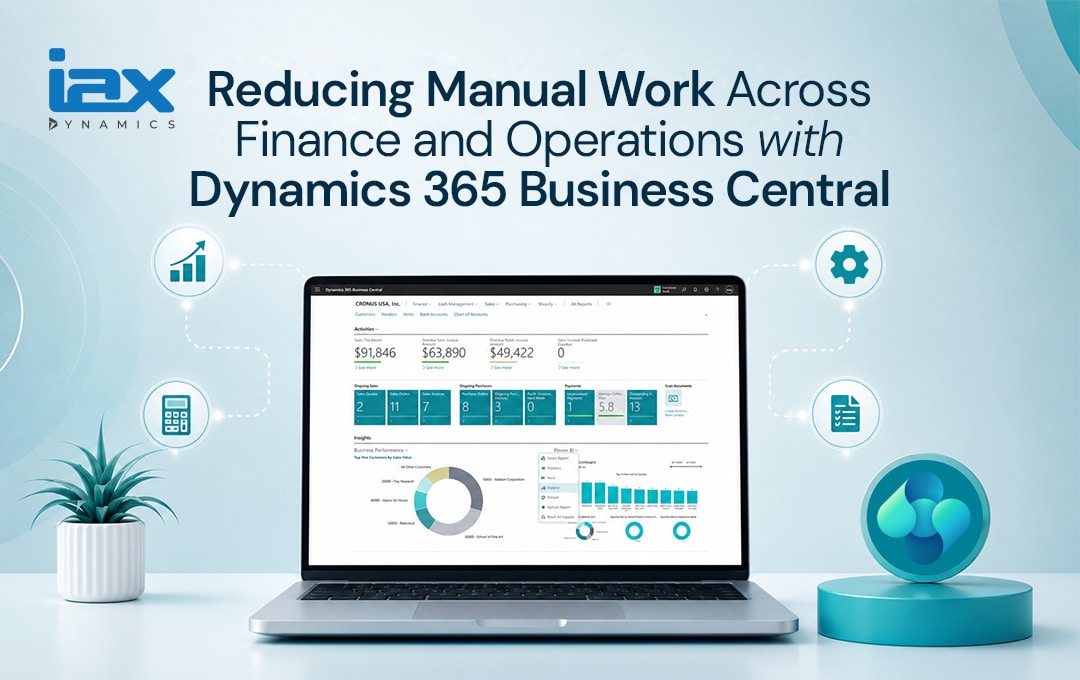
Do manual operations hold your business back? Looking to modernize operations with modern ERP solutions like Microsoft Dynamics 365 Business Central?
Today is the era of automation, and companies who still rely on traditional, fragmented ERP systems have to pay a big price. Disconnected systems, manual data entry, and constant switching between spreadsheets not only slow down your team but also invite costly errors.
Today’s solutions are advanced with AI features, and Dynamics 365 Business Central is no exception. Powered by Microsoft AI, businesses can expect more than just standard automation they get intelligent assistance.
Automation is at the heart of Business Central, and it is clearly evident in how core finance and operations are processed.
What is Dynamics 365 Business Central?
Dynamics 365 Business Central is a comprehensive, cloud-based ERP solution designed for small to mid-sized businesses. It seamlessly integrates sales, finance, customer service, HR, and supply chain modules into a unified platform.
The platform is driven by advanced AI and autonomous AI agents, giving businesses complete control over financial management, inventory and procurement, manufacturing, warehousing, and logistics operations.
Its adaptable nature combined with easy customization options, advanced generative AI, and deep integration features gives Business Central a massive advantage for various industry use cases.
Whether your business is in manufacturing, retail, hospitality, or the government sector, this ERP delivers exceptional value.
Transforming Finance with Automation
Repetitive tasks within finance operations are challenging, as they involve a lot of effort for manually entering data, reconciling bank transactions, preparing reports, and closing financial periods.
In Business Central, financial processes are seamlessly interconnected with sales, procurement, inventory, and other core departments. The moment a sales process occurs, the associated financial transactions are instantly initiated and processed in the background without requiring manual data entry. This ensures that financial records remain updated without requiring repeated manual intervention.
These are the areas where automation in Business Central financial management directly benefits teams.
Automated Bank Reconciliation
The manual way of doing bank reconciliation is tedious. Financial teams must download bank statements, compare each transaction with accounting records, identify mismatches, and manually enter reconciled data.
Business Central automates these processes. It offers intelligent capabilities for automatically comparing transactions with financial records, identifying entry mismatches, and highlighting where manual review is needed.
This automation reduces reconciliation time, minimizes errors, and improves financial accuracy, helping finance teams save time and focus on more strategic activities.
Month-End Closing
Financial closing is challenging when done manually. It requires preparing statements, posting recurring journals, adjusting accruals, reconciling accounts, and consolidating financial data from various entities.
Business Central simplifies the financial closing process by automating many of these routine activities. Accrual allocations, cost allocations, bank reconciliations, inventory cost adjustment, fixed asset depreciation, multi-currency adjustments, and the management of posting periods are all handled seamlessly in the background.
Instead of relying on manual processes, automated batch jobs update the ledger with absolute precision. This reduces the time required to close the books, ensuring compliance and giving leadership immediate access to the past month’s financial performance.
Real-time Reporting and Analytics
Gone are the days of exporting accounting data into Excel to prepare financial reports.
Business Central supports real-time reporting through the direct analytics of live financial data. The integration with Power BI allows users to create interactive dashboards and comprehensive financial reports without manually compiling data from different sources.
This real-time reporting ensures business leaders always know the exact financial status of the company. They can instantly monitor cash flows, revenue, expenses, profitability, and other key performance indicators (KPIs) through dynamic dashboards.
Ultimately, this level of financial visibility supports faster, data-driven decision-making and enables organizations to respond proactively to unexpected market changes.
Optimizing Supply Chain Operations
Supply chain operations are an amalgamation of procurement, inventory, manufacturing, warehousing, and finance.
Business Central combines these processes into a single platform. This ensures that all data are available from a centralized location, making it easier for coordinated actions between procurement, inventory, manufacturing, and other teams.
Smart inventory and demand forecasting
Real-time inventory management within Business Central helps companies drive manufacturing efficiently. The platform provides complete visibility into inventory across various locations while supporting automated purchase requisitions when inventory falls below a certain threshold. This allows businesses to maintain optimal stock at all times to ensure continuous manufacturing.
Business Central uses historical sales data, purchasing trends, external signals, seasonal demand patterns, and current inventory to forecast future demand precisely. The automation of predicting demand and inventory management reduces the dependency on manually checking inventory and sales data for forecasting.
Automated Production Scheduling
Production scheduling in a traditional way involves using spreadsheets or disconnected software. This becomes difficult when demand changes or production resources are not available.
Business Central simplifies this process through the automatic generation of production schedules based on real-time data such as customer orders, available inventory, production capacity, machine availability, and labour resources.
Production schedules are automatically updated with any changes in demand, customer orders, or inventory availability. This automated scheduling improves resource allocation, boosts production efficiency, and helps meet customer requirements with on-time deliveries.
Unified Production Floor and Ledger
Business Central integrates production and finance processes, ensuring every production transaction is instantly reflected in both operational and financial records. As raw materials are issued to production, their actual consumption and material costs are recorded.
The same applies to labour costs, machine hours, and overhead expenses as production progresses. Once production is completed, finished products are automatically added to inventory, and the system calculates the total production cost based on materials consumed, labour, and overhead allocations.
This unified approach eliminates manual tracking discrepancies, improves financial accuracy, and enables faster decision-making across both manufacturing and finance departments.
The other operational areas that benefit from Business Central automation include:
Manufacturing: With Business Central manufacturing features, businesses can easily automate production orders, material requirements planning (MRP), bills of materials (BOMs), resource allocation, and work order tracking.
Automated Approval Workflows: Business Central allows teams to configure automated workflows for purchase approvals, expense reports, sales discounts, financial documents, and vendor onboarding validation.
Looking to Improve Financial and Operational Success?
When you are looking to modernize your operations with modern ERP, it is worthwhile going for Dynamics 365 Business Central Implementation. IAX DYNAMICS, with proven expertise in consultation, customization, integration, and implementation, offers solutions tailored to your business needs.
No matter how complex your internal processes may be, our D365 consultants implement the ERP system with a thorough, localized understanding of finance and supply chain operations.
You can confidently move ahead with Business Central financial management and Business Central manufacturing features through a structured, proper implementation. When you are ready to leverage the full power of advanced automation and AI across your finance and operations departments, get in touch with the experts at today to schedule a personalized consultation.
FAQ Section
How does Business Central benefit manufacturing operations?
Business Central encompasses planning tools which helps with precise production planning, job scheduling, production scheduling, demand forecasting, inventory management, and more. Users can create intelligent factories that leverages AI, analytics, and IOT to enhance production efficiency with real-time visibility.
How does Business Central reduce manual work in finance?
It automatically links financial transactions related to operations directly to the general ledger, removing the need for manual data entry. It automates reconciliation, cash flow prediction, and financial closing, while identifying risky customers.
What modules are supported in Business Central?
Business Central integrates Dynamics 365 apps for managing sales, finance, customer service, and supply chain operations. Besides providing operational functionalities, the ERP leverages enterprise-grade AI, advanced analytics, and automation to streamline operations.